Check out Rebecca Frost Davis' great commentary!
Crowdsourcing, Undergraduates, and Digital Humanities Projects « Rebecca Frost Davis
Crowdsourcing could be a silver bullet for integrating digital humanities methods into the undergraduate curriculum. Why?
Crowdsourcing means getting the general public to do tasks. Jeff Howe explains the phenomenon in “The Rise of Crowdsourcing” (Wired Magazine, June 2006) by analogy with outsourcing. This method of labor is growing for scholarly and cultural heritage projects, and that’s where it intersects with the undergraduate curriculum. Collaborative manuscript transcription projects, like Transcribe Bentham,
have received quite a bit of the attention, but there are a variety of
opportunities out there for motivated students to engage in the process
of digitizing, preserving, and studying collective resources and data.
Click Here to read more -->>
Musings on California History, Historians, Historiography, and the American West
Wednesday, September 5, 2012
Thursday, February 2, 2012
Black History Month: A Celebration Of African American Angelenos
Glimpse into African American culture in Southern California. Regionalism is alive and well. Check out Gilded Empire for more information on California regional identity.
From Huffington Post, Los Angeles:
"African Americans have played a pivotal but often forgotten role in the history of Los Angeles. From the days of the pueblo, through the civil rights movement, to now, black Angelenos have broken barriers and pioneered a community where talent is not deterred by the color of one's skin."
"Celebrating Black History Month, The Huffington Post presents journalists, musicians, city officials, architects, athletes and others who have changed our city for the better. Some are household names, others are much less known, but they all forged courageous paths through this diasporic city."
Friday, January 27, 2012
“California's Right to Vote” on display at Museum
“California's Right to Vote” on display at Museum asd f
From Gridleyherald.com:
"Gridley, Calif. — The California Women's Right to Vote traveling display has arrived at the Gridley Museum and will remain until mid February. It is because of the League of Women Voters that the wonderful display is here at our museum. Tonight, Friday, January 27, 2012, the Gridley Museum is hosting a Wine and Cheese Reception from 6:30 to 8 p.m., to kick-off the display in Gridley. For the full story, please pick up a 1/27/12 edition of The Gridley Herald."
New Narratives for "Living in a Modern Way": California Design at Mid-century
Event:
Los Angeles County Museum of Art
Bing Theater
Friday, February 24 | 10 am-5 pm with keynote panel at 7 pm
Saturday, February 25 | 9:30 am-5 pm
FRIDAY, FEBRUARY 24
California Modernism North and South: Two Regions, One Reality
Pierluigi Serraino
Modernism at the Beaux-Arts Ball: The Architecture of the San Francisco
World's Fair of 1939
Andrew Shanken, UC Berkeley
The Arts of Daily Living: Modern Design at the Los Angeles County Fair,
1954
Monica Penick, University of Wisconsin-Madison
College Art Association (CAA) Centennial Session: Connections:
Architecture and Design in Los Angeles at Mid-century
Changing Taste: LA Architects Promote Modernism
Wim de Wit, Getty Research Institute
Panel Discussion
Louis Danziger, graphic designer
Ray Kappe, architect
Gere Kavanaugh, designer
Ruth Weisberg, moderator
Bobbye Tigerman, discussant
Keynote Panel Discussion: Blurring the Boundaries: California Design and
Contemporary Art
Jim Iserman, artist
Jorge Pardo, artist
Pae White, artist
Frances Anderton, moderator
SATURDAY, FEBRUARY 25
Scandinavian Design Comes To California: Humanism, Art and Technology
Nina Stritzler-Levine, Bard Graduate Center
Richard Neutra: Mystery and Realities of the Site
Marc Treib, UC Berkeley
Warren McArthur in Los Angeles
Donald Albrecht, Museum of the City of New York
Beyond (and Before) Eames: The Reinvention of Plywood
Christopher Wilk, Victoria & Albert Museum
"We Live a Normal, Natural Life": Aliso Village, Los Angeles and the
Promise of Racially Integrated, Modern Living
Elizabeth St. George, Bard Graduate Center
Crossing Paths: African-American Designers and Craftspeople in Los
Angeles
Staci Steinberger, Los Angeles County Museum of Art
Wake Up Call: California Design after 1965
Glenn Adamson, Victoria & Albert Museum
Two-day pass: $25 general admission; $15 LACMA members; free to students
with ID and College Art Association members
One-day pass: $15 general admission; $10 LACMA members; free to students
with ID and College Art Association members
Tickets: 323 857-6010 or purchase online
symposium tickets include museum general admission
For the complete program and more information, visit
This symposium was organized by the Los Angeles County Museum of Art and
made possible by --the Karsh Family Foundation and the Boardman Family
Foundation.
Saturday, January 21, 2012
FREE MUSEUM DAY IN THE SACRAMENTO AREA - Sacramento Contemporary Art | Examiner.com
"February 4th 2012 is free Museum admission day in the Sacramento area."
"This will be the 14th year this has been offered in Sacramento. There are 28 museums in the greater Sacramento area. Most are offering free or half price admission on this day. It is presented by the Sacramento Association of Museums. (SAM) These Museums cover art, history, science and wildlife."
Lunar New Year Around the World « Pacific Asia Museum
As the new Year of the Dragon approaches, Lunar New Year will be quite an event in San Francisco. The Oakland Museum of California will be hosting a celebration this coming weekend. Click here for more information on the OMCA's event.
"OMCA ‘s 11th annual Lunar New Year Celebration and Other Asian Traditions: Year of the Dragon features a full afternoon of celebration, festivities, performances, demonstrations, and workshops that include elements of Chinese, Korean, Vietnamese, Japanese, Tibetan, and other Asian cultures."
The Pacific Asia Museum in Pasadena, California will also be holding some exhibits honoring the lunar new year. (Lunar New Year Around the World « Pacific Asia Museum)
"Our Lunar New Year Festival was a smashing success, but the fun isn’t over yet! This year, we’re proud to be hosting a delegation of artists and performers from Jiangsu Province, China, who will be demonstrating their talents through Friday. Most engaging are the puppeteers, who have delighted several school groups this week and will have public performances this afternoon and tomorrow at 3:30 p.m."
Friday, January 6, 2012
Bay Area History: Celebrate the Golden Gate Bridge's Approval!
Attention California Bay Area history enthusiasts! Celebrate the Golden Gate Bridge on Sunday, February 26, 2012, 3:30 - 5:30pm.
"Put on your party clothes and come help us celebrate the opening of A Wild Flight of the Imagination: the Story of the Golden Gate Bridge. On this day in 1933 San Franciscans celebrated the ground breaking for the Bridge, a symbol of hope in a devastated economy. Come kick up your heels to the band, gather around the classic cars parked outside, and learn the story of the Bridge."
Tuesday, December 20, 2011
Adventuring, Reminiscence, and Nostalgia: A Path to an Early California Identity
In understanding San Francisco's urban collective identity in any one context requires the computation of multiple values of power and politics. Urban collective identity is the product of competing group's visions of the city vying for dominance within the public sphere (see my post). This competition often pits very divergent visions against each other. The Society of California Pioneers for instance competed as early as the 1850s to establish their vision of the city's history into the public narrative. Their vision, grounded in the romantic pre-American conquest Alta California, put particular historical significance on the cultural and economic seeds sown by California's first Anglo-American pioneers. The first pioneers the Society suggested, saw little to revere in the cosmopolitan mass that had developed on the cove of Yerba Buena or throughout California since statehood........
Read More --->
Read More --->
![]() |
| Diploma given to members of the Society of California Pioneers. Image courtesy of Online Archive of California.org |
Thursday, December 15, 2011
San Francisco and The City Beautiful
To the Cloud: Pasted below is an excerpt from the introduction to my latest project. I believe it sums up my goals pretty well.
In the late-19th century, San Francisco represented an almost imperial influence over northern California’s economy and culture. With the rise of progressivism and the maturation of cultural hierarchies in California, many of San Francisco’s commercial-civic elite displayed a particular vision of what they saw as the city’s collective identity. This vision, built out of the legacies of “California’s pioneer gold rush myth,” not only gave San Francisco’s elite classes a usable identity in a dramatically changing urban landscape, but also demonstrated their continual desire for social order and harmony.
“Ordering the disorderly city” by San Francisco’s commercial-civic elite, according to Barbara Berglund, significantly structured the city’s social landscape. By controlling the discourse on public policy, public space, and politics, San Francisco’s elite overwhelming structured the lives of the city’s inhabitants. However, as Berglund points out, this “cultural ordering” is not a hegemonic force. In living in a 19th century city like San Francisco, residents and consumers demonstrated their own “consumer” structuring of the city. By residents living, consuming, and building their own private lives according to their own vision of the city’s identity, the elite’s “cultural ordering” was moderated, redirected, or blunted in ways that no one intended. It is in these inter and intra-class discourses, mediated significantly by market forces and individual consumption Berglund argues, that shape and mold how any one group (or theoretically any individual) perceives the city’s collective identity.
For San Francisco of the 1890s, cultural ordering from above and consumptive ordering throughout represents a significant historical problem. How as historians are we to discern what vision of the city any one particular group believes? As David Glassberg has point out, detecting collective identity is easiest when it is being purposely deployed. Civic celebrations in the 19th and early 20th century in particular explicitly deploy a collective identity by its organizers or participants. To celebrate publicly in San Francisco California Admission Day for instance, those participants are not only declaring themselves Californian, but a particularly San Franciscan vision of being Californian.
It is through these types of civic and public displays where group and collective identity can be investigated with some certainty. In San Francisco of the 1890s, civic and public displays were rich with symbolism, imagery, and dialogues of social power. It is in this vein where I hope to find the battle of San Francisco’s collective identity being played by various groups vying for their visions of the city being displayed to the public. The Native Sons’ of the Golden West for instance publicly displayed not only their hatred for the Chinese, but also demonstrated their own vision of San Francisco’s social order and thereby its collective identity. However no one group dominated the narrative of the city’s collective identity. Over time various group’s power to influence the collective narrative waxed and waned with the deployment of parallel and congruent forms of power such as political influence, economic dominance, or cultural leadership.
How are we to measure an urban collective identity? Who determines what the outcome of this symbolic battle for an urban identity (the product of cultural ordering and consumptive ordering over time)? It is through memory, tradition, histories, literature, and art, ultimately that establishes any constant to urban collective awareness. As David Lowenthal suggests, collective self-awareness is constructed through weaving a “web of retrospection” through memories, histories, and relics. For San Francisco it would be Bret Harte, Joaquin Miller, Hubert Howe Bancroft, John S. Hittell, Frank Norris and Jack London to only name a few, that created a collective continuity to San Francisco’s identity. Any challenge to the city’s collective identity, whether from the elite or from below, had to reconcile with the established narrative.
As Glen Gendzel points out, San Francisco was dominated throughout the 19th century by a “Pioneer Gold Rush” narrative myth. In Lowenthal’s words, “all present awareness is grounded on past perceptions and acts.” The already fabled narrative of San Francisco’s “Pioneer” origin was thickly established and displayed in history books, public displays, and in the memories of inhabitants into the First World War. Any group’s challenge of that established narrative in writing, public displays, or in daily life, had to reconcile with the memories, histories, and relics of the city’s pioneer and mining past. And as Gendzel reminds us, challenges to the established narrative were numerous. Nevertheless, the competition between established and insurgent narratives of the city’s past and present narrative present a ripe landscape for understanding urban social power in the late-19th century city.
San Francisco in particular, with a demographic legacy of cosmopolitanism, the struggle for ordering the city’s collective narrative was volatile, especially in the 1880s and 1890s. With the ascendance of James D. Phelan as Mayor in 1897, bringing with him a heavy progressive influence to the city’s collective identity. Phelan’s visions of a City Beautiful demonstrated how a single individual can mold the city’s image along his own vision. But few individual’s actions would converge with such power like James D. Phelan in the 1890s, Dennis Kearney in the 1870s. And even for ourselves as historians, Hubert Howe Bancroft who has had a dramatic impact on how historians understand California in the 19th century, has had great influence on perpetuating the Pioneer Gold Rush Myth of San Francisco and of California. How influential can one individual be on an urban collective identity? Does the concept of an “urban collective identity” even effective at understanding the past? My blog at Gilded Empire is an attempt to simply work through the influences on a collective narrative of San Francisco’s urban identity in the late-19th century.
Wednesday, November 9, 2011
Academia, Multi-Tasking, and Deadlines!
Here we go. Its been a busy semester and with so much of my time wrapped in my first article, I have little time for blogging on other topics. I have been posting regularly on Gilded Empire and not-so-regularly on Twitter @calhistorian. My original intention still stands to attempt to bring issues of California history to a broader audience, but it seems it will be more punctuated than consistent. But thats the way it goes.
Monday, October 24, 2011
Identity Participation & California Regionalism
It was a funny thing growing up in the Sierra Nevada Mountains of California in the 80s and 90s. Besides "Hammer" pants and Seattle "grunge," among other things, my community remained relatively isolated from national trends in fashion, music, & mass urban popular culture. The cities and "the city" (read San Francisco) were places far distant, but strangely familiar. However in the late 90s a new imagined California identity emerged. This new northern California identity came with little fanfare, yet by the time I left high school in the late 90s it was clear that "NorCal," as one commercial brand put it, was more than just a state of mind, but an identity with varying levels of participation. Thinking about this regional identity in hindsight illustrates two distinct issues of regional identity. First, one is geographic. Simply living in Northern California, I was almost obliged to identify with "NorCal" or a Northern California identity. However, on the other hand, identity is also participatory. Did I participate in this northern identity, or simply benefit from it?
This 21st century paradox of space and identity I imagine was not all that different from Northern California a hundred years prior as I look at it in San Francisco in the 1890s. By the time I left for the University of California in 2007, I seemed to almost appropriate this identity, not through comparison, but through contrast. I was NOT Southern Californian! One factor which influenced my identification with Northern California was the urban spaces I associated with. As a rural resident, I identified myself as rural. But at the same time I wasn't just a citizen of Tuolumne County, but of California, and the United States. Psychologically my identity stretched to Washington D.C., San Francisco, other satellite urban spaces in which I interacted. While Sacramento provided a image of civic governance and state power, it was San Francisco which filled my visions of the quintessential city, the apex of urban development. It was images and visions of San Francisco when I thought of cities and the urban environment.
While certainly there are geographic levels of association to urban places. The nearest city, Sonora, California, was for a long time my only reference to such an agglomeration of capital, people, and architecture. But as I widened my experience beyond my home county, San Francisco came to represent the center of Northern California culture. The apex of science, art, culture, and urbanity, could all be readily drawn from "the city by the bay." So when I evaluate regional identity in 1890s California, do we see a similar situation of geographically split identity as I experienced myself?
According to historian Glen Gendzel (Pioneers and Padres: Competing Mythologies in Northern and Southern California, 1850-1930. 2001) and others, two distinct regional identities existed in the late 19th century as well as into today. Centered on the "instant city," a Northern California identity matured as San Francisco and the northern part of the state developed into a wide and productive mining and commercial economy. In contrast, in the 1880s, Los Angeles began to see its own development mature into an urbane future. As the Southern Pacific Rail Road, floods of midwest migrants, as well as Mexican immigrants developed the southern part of the state, San Francisco began to see that the legacy of the Bear Flag Republic, the Gold Rush, and dominance of the Pacific market was being challenged by the supremacy of LA, its population, and its inland empire.
While San Francisco came to see its own past as based in "Pioneer Myth," it easily incorporated California's Spanish and Mexican heritage as subjugated historical memories. The Spanish and Mexican periods, the Pioneer myth illustrates, was supplanted by the more industrious and pious christians from the East. The 1894 California Mid-Winter Fair held in San Francisco was precisely this declaration of Anglo- and San Franciscan supremacy and dominance of the new emerging California. Perhaps in contrast to Gendzel, who points to two independent and competing regional identities based in the south and north, maybe it is more appropriate to argue that L.A. appropriated the Spanish and Mexican legacy out from under San Francisco's pioneer legacy as it rose to prominence in the 1890s and 1900s.
Therefore while we can agree that two distinct regional identities operated, derived from two urbane spaces and regional imiaginations (SF & LA), were they mutually exclusive? In other words are we still stuck in a theoretic rut by assuming that identity is static, conforming, or unintelligent? As I had difficulty when I was young figuring out which 'identity' to accept (Northern or Southern), identity in the 1890s was likely influenced by similar ambiguities. Thus, how are we to determine historically how a person identifies themselves? If we accept Mexican-American historian George Sanchez's model (Becoming Mexican American, 1993) of cultural adaption, “any notion that individuals have occupied one undifferentiated cultural position - 'Mexican,' 'American,' or 'Chicano'” must be abandoned for the sake of accepting "multiple identities." For me the new paradigm is participation and multiplicity. How are we to understand Chinese and Japanese participation in the pioneer myth of San Francisco? What discourses played between these seeming contrasting identities? Or, as with my case, how do we reconcile a rural identity which is intimately bound to an urban space, like San Francisco and the pioneer myth? These are just some of the questions I am grappling with in my project blog, Gilded Empire.
This 21st century paradox of space and identity I imagine was not all that different from Northern California a hundred years prior as I look at it in San Francisco in the 1890s. By the time I left for the University of California in 2007, I seemed to almost appropriate this identity, not through comparison, but through contrast. I was NOT Southern Californian! One factor which influenced my identification with Northern California was the urban spaces I associated with. As a rural resident, I identified myself as rural. But at the same time I wasn't just a citizen of Tuolumne County, but of California, and the United States. Psychologically my identity stretched to Washington D.C., San Francisco, other satellite urban spaces in which I interacted. While Sacramento provided a image of civic governance and state power, it was San Francisco which filled my visions of the quintessential city, the apex of urban development. It was images and visions of San Francisco when I thought of cities and the urban environment.
While certainly there are geographic levels of association to urban places. The nearest city, Sonora, California, was for a long time my only reference to such an agglomeration of capital, people, and architecture. But as I widened my experience beyond my home county, San Francisco came to represent the center of Northern California culture. The apex of science, art, culture, and urbanity, could all be readily drawn from "the city by the bay." So when I evaluate regional identity in 1890s California, do we see a similar situation of geographically split identity as I experienced myself?
According to historian Glen Gendzel (Pioneers and Padres: Competing Mythologies in Northern and Southern California, 1850-1930. 2001) and others, two distinct regional identities existed in the late 19th century as well as into today. Centered on the "instant city," a Northern California identity matured as San Francisco and the northern part of the state developed into a wide and productive mining and commercial economy. In contrast, in the 1880s, Los Angeles began to see its own development mature into an urbane future. As the Southern Pacific Rail Road, floods of midwest migrants, as well as Mexican immigrants developed the southern part of the state, San Francisco began to see that the legacy of the Bear Flag Republic, the Gold Rush, and dominance of the Pacific market was being challenged by the supremacy of LA, its population, and its inland empire.
While San Francisco came to see its own past as based in "Pioneer Myth," it easily incorporated California's Spanish and Mexican heritage as subjugated historical memories. The Spanish and Mexican periods, the Pioneer myth illustrates, was supplanted by the more industrious and pious christians from the East. The 1894 California Mid-Winter Fair held in San Francisco was precisely this declaration of Anglo- and San Franciscan supremacy and dominance of the new emerging California. Perhaps in contrast to Gendzel, who points to two independent and competing regional identities based in the south and north, maybe it is more appropriate to argue that L.A. appropriated the Spanish and Mexican legacy out from under San Francisco's pioneer legacy as it rose to prominence in the 1890s and 1900s.
Therefore while we can agree that two distinct regional identities operated, derived from two urbane spaces and regional imiaginations (SF & LA), were they mutually exclusive? In other words are we still stuck in a theoretic rut by assuming that identity is static, conforming, or unintelligent? As I had difficulty when I was young figuring out which 'identity' to accept (Northern or Southern), identity in the 1890s was likely influenced by similar ambiguities. Thus, how are we to determine historically how a person identifies themselves? If we accept Mexican-American historian George Sanchez's model (Becoming Mexican American, 1993) of cultural adaption, “any notion that individuals have occupied one undifferentiated cultural position - 'Mexican,' 'American,' or 'Chicano'” must be abandoned for the sake of accepting "multiple identities." For me the new paradigm is participation and multiplicity. How are we to understand Chinese and Japanese participation in the pioneer myth of San Francisco? What discourses played between these seeming contrasting identities? Or, as with my case, how do we reconcile a rural identity which is intimately bound to an urban space, like San Francisco and the pioneer myth? These are just some of the questions I am grappling with in my project blog, Gilded Empire.
Friday, October 7, 2011
Apple & Steve Jobs
Sometimes history comes at us with no question to its eventual or even immediate impact on our lives and the course of history. Steve Jobs certainly moved our society in a direction of his design. He will be remembered for more than just Apple and "i" products. Steve Jobs was a man of Palo Alto as well. Living somewhat close to such an influential figure makes you realize how real these giants are, but also how giant one can become by striving and pushing for their dreams. While it sounds cliché, visiting the makeshift memorial at his home brought these thoughts forward. I have included a few photos, taken from my iPhone of course!
Labels:
Apple,
Home,
Memorial,
October 6,
Palo Alto,
RIP,
Steve Jobs,
Visionaries
Tuesday, September 27, 2011
Check out my new blog posts @ Gilded Empire. New material on San Francisco in 1897 and issues of public memory and historical imagination ---> Gilded Empire <---
Wednesday, September 21, 2011
California Lectures
For all of those Bay Area historians and Native American buffs. There is a lecture from the Department of Justice Studies at San Jose State University (Flyer below) October 12, 2011 titled, "Grave Matters: Excavating California's Buried Past" by Tony Platt. Speakers include Libra Hilde (my current Graduate Advisor) who received her BA in Native American Studies from Harvard and Alan Leventhal of SJSU's Anthropology Department. It should be a great afternoon regarding some of the most contentious issues in Native American politics and California History. I will be there. Check it out!
Friday, September 9, 2011
Admission Day in California
Well 161 years ago California was admitted as the 31st state. Does admission day mean anything anymore? Certainly contemporaries in the 19th century saw a great significance in celebrating the admission of their new state, but with national geographic expansion almost fading in the 21st century in many historical imaginations what does it mean now?
During the 1890's California Admission Day celebrations were huge affairs of parades, fairs, and expositions. Most significantly, Admission Day's provided an institutionally sanctioned set of historical memories that would be propagated each year at the end of the summer. For instance, many attractions at Admission Day's would carry connotations of the significance of the Anglo-gold rush, the removal of the Mexicans from sovereignty in Alta California, and California's significance overall to national prestige in its seeming Pacific empire to the west.
In regards to my current project, Gilded Empire, what is the significance of Admission Day?
San Franciscan's particularly celebrated Admission Day with huge excitement. Despite Sacramento being the capital, SF played a crucial role in establishing a constellation of urban ideas and national concepts which structured historical memories and the social imaginations of those whom participated in the celebrations. In San Francisco those whom participated in these celebrations, consciously and unconsciously, engaged in a dialogue between their own historical memories and those presented by the politically powerful. While these dialogues would cause little cognitive dissonance in those who identified with the powerful's historical memories, conflict and incongruities between the lower class, ethnic minorities, and immigrant's historical memories can disrupt, modify, or reinforce their own identities.
The significance of this phenomena outlined above really comes in to play when you ask the question, how political power can influence the way a "city" or the urbane sees itself while also remaining in dialogue (conflictual or otherwise) with those whom occupy the same urban space? And in San Francisco, the urban sphere was far from demographically homogenous. What does this mean when we ask, whose city is it?
During the 1890's California Admission Day celebrations were huge affairs of parades, fairs, and expositions. Most significantly, Admission Day's provided an institutionally sanctioned set of historical memories that would be propagated each year at the end of the summer. For instance, many attractions at Admission Day's would carry connotations of the significance of the Anglo-gold rush, the removal of the Mexicans from sovereignty in Alta California, and California's significance overall to national prestige in its seeming Pacific empire to the west.
In regards to my current project, Gilded Empire, what is the significance of Admission Day?
San Franciscan's particularly celebrated Admission Day with huge excitement. Despite Sacramento being the capital, SF played a crucial role in establishing a constellation of urban ideas and national concepts which structured historical memories and the social imaginations of those whom participated in the celebrations. In San Francisco those whom participated in these celebrations, consciously and unconsciously, engaged in a dialogue between their own historical memories and those presented by the politically powerful. While these dialogues would cause little cognitive dissonance in those who identified with the powerful's historical memories, conflict and incongruities between the lower class, ethnic minorities, and immigrant's historical memories can disrupt, modify, or reinforce their own identities.
The significance of this phenomena outlined above really comes in to play when you ask the question, how political power can influence the way a "city" or the urbane sees itself while also remaining in dialogue (conflictual or otherwise) with those whom occupy the same urban space? And in San Francisco, the urban sphere was far from demographically homogenous. What does this mean when we ask, whose city is it?
Wednesday, August 24, 2011
Return to Academia
Hello cloud. My posts have been slim the last month due to the celebration of my 30th birthday. But as any self respecting historian, anywhere you tread, history exudes from the very physicality of the landscape.
From Yosemite over Tioga, then Sonora and Ebbets Passes my fiancé and I lived and breathed the Sierra Nevada. To walk through the California gold fields of today and imagine the upheaval of Anglo empire; climb the John Muir Trail to explore what was a spiritual experience for many 19th century folks; to see the Big Trees of Calaveras, the tuft of Mono Lake, and to climb the longest ridge line in the Sierras is something that is hard to experience through a presentist perspective without falling into the mindset of historical inquiry.
The history of the Sierras of California is quite diverse and unique. While many national historical trends equally affected the path of American California, many more phenomena were entirely unique; Stanford was not like Gould and Gould never became a popular senator (as one example). My goal is to illustrate this Western and California uniqueness through this blog and my side projects. Check out my Gilded Empire Blog for more of my interests and San Francisco's role in the late 19th century. And thanks again to all the #twitterstorians for their inspiration.
Check out my blog Gilded Empire for details on the new project I am working with. Lets begin Fall 2011!
From Yosemite over Tioga, then Sonora and Ebbets Passes my fiancé and I lived and breathed the Sierra Nevada. To walk through the California gold fields of today and imagine the upheaval of Anglo empire; climb the John Muir Trail to explore what was a spiritual experience for many 19th century folks; to see the Big Trees of Calaveras, the tuft of Mono Lake, and to climb the longest ridge line in the Sierras is something that is hard to experience through a presentist perspective without falling into the mindset of historical inquiry.
The history of the Sierras of California is quite diverse and unique. While many national historical trends equally affected the path of American California, many more phenomena were entirely unique; Stanford was not like Gould and Gould never became a popular senator (as one example). My goal is to illustrate this Western and California uniqueness through this blog and my side projects. Check out my Gilded Empire Blog for more of my interests and San Francisco's role in the late 19th century. And thanks again to all the #twitterstorians for their inspiration.
Check out my blog Gilded Empire for details on the new project I am working with. Lets begin Fall 2011!
Sunday, July 17, 2011
Thoughts & Questions:
Have we as Americans lost our regional consciousness that began so strong in the 18th century? Or has it been overshadowed by our preoccupation with our own national consciousness?
While these questions are vague, they point to a longstanding continuum of social identity in this country. Western historians would cringe to hear anyone discredit regionality historically; especially in the American West. Yet is this the direction we are facing with national media and the cloud? As I write this blog and tweet at @calhistorian I myself am living predominantly in a national life, not regional or local. My political media intake rests on national audience pressures and generalized coverage for the masses. While the digital world has obliterated the tyranny of space, has this only silenced the micro and local world where we actually exist or at least rendering it insignificant? Problems in local governance, general public apathy, and a weak civil culture are, it seems, manifestations of this movement towards a unrooted national consciousness.
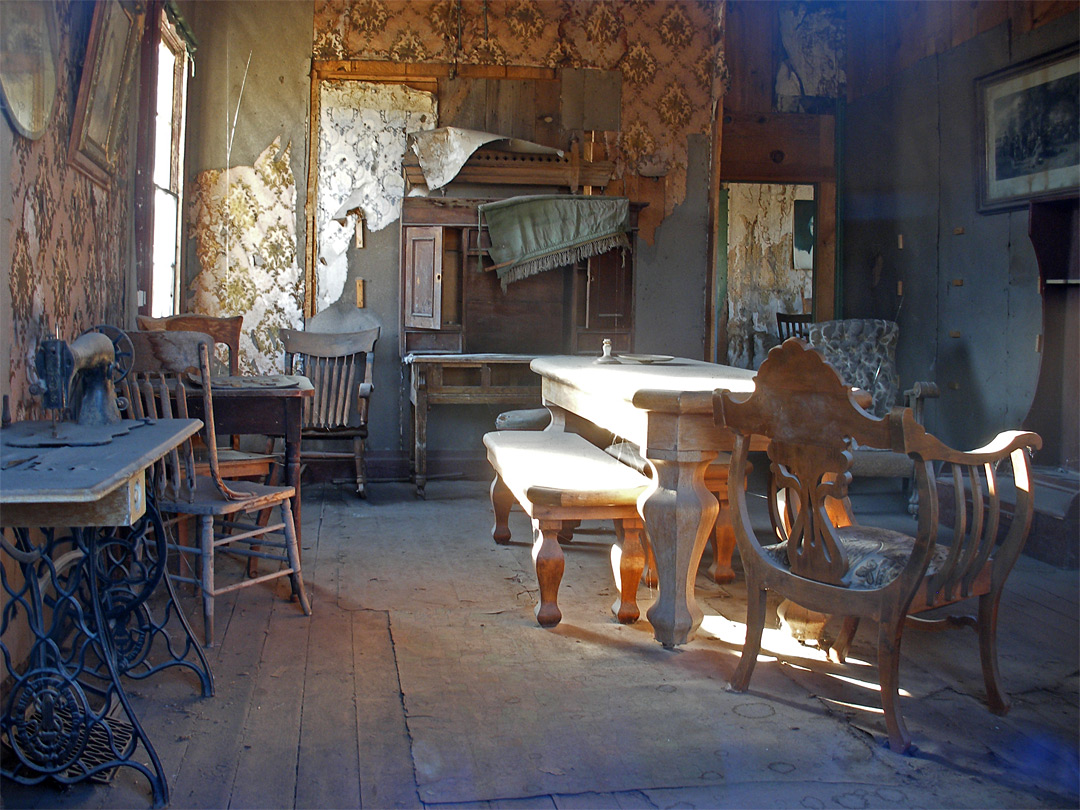
Bodie: Within the Gilded Empire
Bodie State Historic Park
One of the most picturesque 'ghost towns' I have ever visited. To walk through the streets and in between the homes leaves a creepy feeling. Tours of the mine are a must. The price reasonable in these economic times, and the payoff is not disappointing. Take the time, investigate and feel the physical history.
As a historian of the 19th century I cannot get past the visions of Rough It melded with the Gilded Age by Mark Twain, as some homes are ornate, papered and adorned, others are breathlessly bare. Of course much I am sure has be staged throughout the park. Yet the juxtaposition is true nonetheless as that was the nature of silver boom towns of the intermountain west.
Several things strike my interest. How the elites of Bodie lived atop the laboring gyre of miners and peddlers leads me into all sorts of ideations. To those atop the froth, Bodie likely was little different but scenery from where they might otherwise invest their time and capital. However to those whom sojourned with a gamble in the mountain desert, a very disjointed life most certainly ensued; one more silent, isolated, and imprisoning than those above. To hear of regional and national news, as opposed to reading it in print is a very different connection to the outer world.
Thoughts:
Closer to my own work, what affiliation if any did those in Bodie give to San Francisco or California as a region or state?
As a historian of the 19th century I cannot get past the visions of Rough It melded with the Gilded Age by Mark Twain, as some homes are ornate, papered and adorned, others are breathlessly bare. Of course much I am sure has be staged throughout the park. Yet the juxtaposition is true nonetheless as that was the nature of silver boom towns of the intermountain west.
Several things strike my interest. How the elites of Bodie lived atop the laboring gyre of miners and peddlers leads me into all sorts of ideations. To those atop the froth, Bodie likely was little different but scenery from where they might otherwise invest their time and capital. However to those whom sojourned with a gamble in the mountain desert, a very disjointed life most certainly ensued; one more silent, isolated, and imprisoning than those above. To hear of regional and national news, as opposed to reading it in print is a very different connection to the outer world.
Thoughts:
Closer to my own work, what affiliation if any did those in Bodie give to San Francisco or California as a region or state?
Saturday, July 16, 2011
Popular Vote v. Electoral College
A popular idea for making California's votes count @SFGate
Can the switch to the popular vote dramatically alter national politics?
In my opinion, regardless of the politics involved in the switch, increased "democracy" is generally positive. But one question that I do have is how will this influence the connection between America's unique local governance structure and national politics?
@ iTunesU under California and the West from The Huntington Library, a webcast titled "For Whome Bell Tolls: What Can Be Done about Local Governance in California?" investigates this unique local government structure.
Digital Archives and Accessibility
The Online Archive of California is one of the most significant tools for investigating California history through the cloud. Being able to essentially browse thousands of documents and collections with a click or search has allowed me to be more prepared for physical visits as well as save myself immense amounts of time. Anyone, academic or lay, interested in California history must at least know this site exists. While it certainly only covers the largest institutions, the OAC saves enough time in order that you can visit the more distant and rural archives which can be just as valuable as the Huntington for certain questions.
Subscribe to:
Posts (Atom)